
A replacement chainsaw chain can look like the one already on your saw and still be the wrong fit. Two chains sold for an 18-inch bar may have different drive link counts, and even a small difference in gauge can stop a chain fitting correctly.
So, how do you know which one to buy?
Before ordering a new chainsaw chain, you need to identify three measurements: pitch, gauge and the number of drive links. These determine whether the chain matches your guide bar and sprocket setup.
This guide explains how to find those measurements, what the different chainsaw chain sizes mean, and how to check that a replacement chain is compatible with your saw.
Pitch
There are four common chain pitches:
- 3/8 Low Profile (Commonly referred to as 3/8lp)
- .325”
- 3/8 (This is standard 3/8 as opposed to the 3/8lp)
- .404”
The best way to determine the pitch of your chain is to look for a marking in one of the following places:
- On your bar (often it is incorporated into the part number on your bar)
- On the drive link or cutting tooth of your chain
- On the rim of your sprocket
- In your chainsaw manual
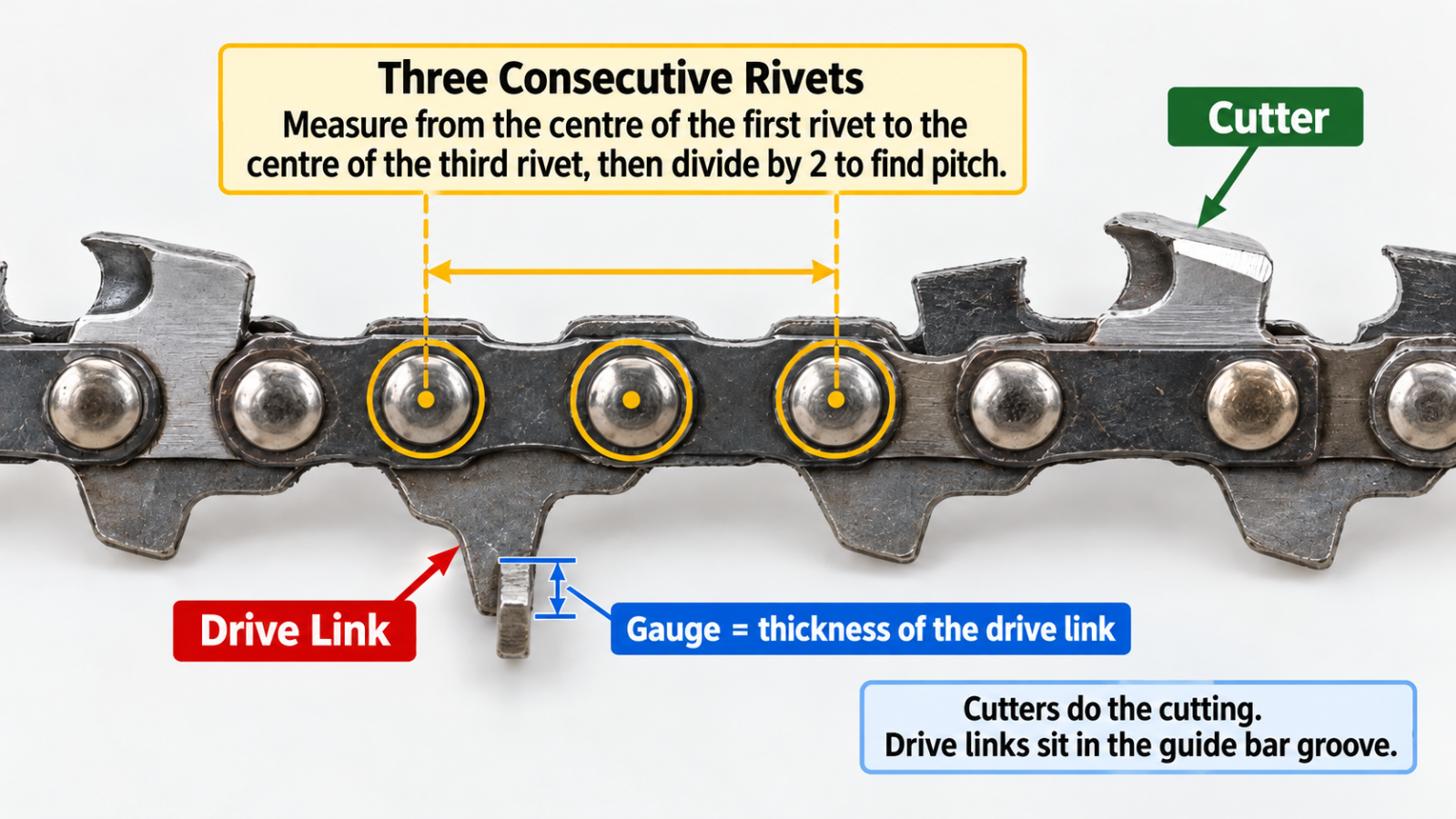
Chain pitch refers to the spacing between the rivets that connect the chain links. To measure it, take the distance from the centre of the first rivet to the centre of the third rivet, then divide that measurement by two.
For example, a measurement of 19.05 mm across three consecutive rivets gives a pitch of 9.525 mm, or 3/8 inch.
The pitch must match your chainsaw's drive sprocket and the guide bar's nose sprocket, where fitted. One detail worth checking is the difference between 3/8 Low Profile and standard 3/8 chain. They have the same nominal pitch but are not interchangeable, so follow the specifications for your saw's cutting setup.
Gauge
There are four common chain gauges:
- .043” (1.1mm)
- .050” (1.3mm)
- .058” (1.5mm)
- .063” (1.6mm)
The best way to determine the gauge of your chain is to look for a marking in one of the places below:
- On your bar (often it is incorporated into the part number on your bar)
- On the drive link or cutting tooth of your chain
- In your chainsaw manual
Gauge is the thickness of the drive links that sit inside the guide bar groove. For example, a chain marked .050 inch (1.3 mm) needs a guide bar with a matching .050 inch groove.
If you cannot find the gauge marking, callipers may help you check the drive link thickness. Measurements taken from a worn chain can be unreliable, though, so the original chain code, guide bar markings or manufacturer's specifications are better references.
Number of Drive Links
- The drive links are the metal tabs on the bottom of your chain that slot into the groove of your bar and run around the sprocket of your chainsaw.
- Count all the drive links around the chain loop to determine the number needed for a replacement. This measurement works together with pitch and gauge to identify the correct chain size.
- Drive links are often abbreviated to DL in many online listings.
Drive link count is especially important because two chainsaws with the same advertised bar length may need chains with different numbers of drive links. A listing marked 56 DL, for example, means the chain contains 56 drive links. It does not mean the chain will fit every saw with a particular bar length.
How To Measure A Chainsaw Chain When The Markings Are Missing
The easiest way to identify chain size is to check the information stamped on the guide bar or printed in the chainsaw manual. But what if the markings have worn away, or you've bought a second-hand saw with an unknown chain?
You can check the old chain directly.
Step 1: Prepare the chainsaw.
Turn the saw off and let the chain cool. Follow the manufacturer's instructions for preventing accidental starting, including disconnecting the power source where applicable. Wear protective gloves when handling the sharp cutters. If you need to remove the chain, follow the saw's manual.
Step 2: Count the drive links.
Lay the removed chain on a workbench and mark one drive link so you know where you started. Count the drive links around the entire loop, not the cutting teeth on top. Record the total.
Step 3: Measure the pitch.
Use a ruler or callipers to measure from the centre of one rivet to the centre of the third consecutive rivet. Divide the result by two and compare it with the standard chain pitches listed above.
Step 4: Check the gauge.
Measure the thickness of a drive link with callipers and compare it with the gauge measurements in the previous section. If the chain is badly worn or the measurement falls between sizes, don't guess. Check the guide bar part number or ask a parts supplier to identify the correct specification.
Once you have all three measurements, compare them against the replacement chain's product listing and the specifications approved for your saw.
Chainsaw Chain Sizes Chart
Chainsaw chains are sold in different pitch and gauge combinations, with drive link counts that vary according to the cutting setup. This chart explains the common measurements and what each one tells you.
| Specification | Common Sizes Or Markings | What It Tells You |
|---|---|---|
| Pitch | 3/8 Low Profile, .325", 3/8", .404" | Spacing between rivets and sprocket compatibility |
| Gauge | .043", .050", .058", .063" | Thickness of the drive links that fit inside the guide bar groove |
| Drive link count | Listed as DL followed or preceded by a number | Total number of drive links in the chain loop |
How To Read Chainsaw Chain Sizes On A Product Listing
A replacement chain listing might show the following specifications:
3/8 LP | .050" | 56 DL
Here's what they mean:
- 3/8 LP: The chain uses 3/8 Low Profile pitch.
- .050": The drive link gauge is .050 inch, equivalent to approximately 1.3 mm.
- 56 DL: The chain loop contains 56 drive links.
All three measurements must match the requirements of your cutting setup. You should also confirm the correct chain profile and any other compatibility instructions given by the manufacturer.
Does Chainsaw Bar Length Determine Chain Size?
A common mistake is assuming that every chainsaw with an 18-inch bar uses the same chain. The bar length describes the cutting length, not the exact chain loop specifications.
Two guide bars with the same advertised length may require different drive link counts. Pitch and gauge can also differ, depending on the chainsaw and bar setup.
If you are unsure of your guide bar length, measuring chainsaw bar length is a separate process from identifying chain size.
For a replacement chain, the safest starting point is the combination of pitch, gauge and drive link count specified for your particular bar and saw.
Which Chainsaw Chain Type Should You Choose?
Once you have confirmed the correct size, the next decision is the cutter design. Different chains are made for different cutting conditions, and the fastest-cutting option is not necessarily the best choice for your saw.
Full-chisel chains have square-cornered cutters that cut efficiently through clean timber. They are commonly used for demanding cutting work but tend to lose their sharp edge more quickly when cutting dirty or abrasive wood.
Semi-chisel chains have slightly rounded cutter corners. They generally hold their edge better when cutting dirty or hard timber, making them a practical option for many regular firewood and property maintenance jobs.
The chainsaw's power, the operator's experience and the manufacturer's recommendations should guide the final choice. Cutter design does not override the need for compatible pitch, gauge, drive link count and chain profile.
Why Won't My Replacement Chainsaw Chain Fit?
Even after checking the product description, you may find that a new chain does not fit as expected. These are some of the first things to investigate.
- The chain won't sit properly in the guide bar groove: Check whether the chain gauge matches the guide bar. A drive link that is too thick will not fit correctly into a narrower groove.
- The chain is too long or too short: Compare its drive link count with the number specified for your bar. Two bars with the same advertised length can require different chain loops.
- The chain doesn't engage correctly with the sprocket: Check the chain pitch and profile against the saw's sprocket and guide bar specifications. Standard 3/8 and 3/8 Low Profile chains should not be substituted for one another.
If the specifications match but the chain still will not fit, stop rather than forcing it onto the saw. Incorrect installation, worn components or a mismatched cutting setup may need attention
The Final Result
If you have managed to determine all three of the above, then you are ready to order your chains.
You can browse our chains by pitch and gauge to find the matching specifications or you can email us at sales@jonoandjohno.com.au with your results and ask us for a price.
Before placing your order, check the full product specifications against the markings on your guide bar or the manufacturer's recommendations.