 |
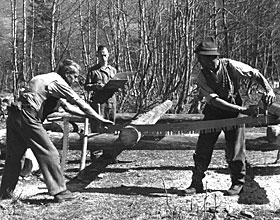
| Early woodcutting using manual saws before the invention of chainsaws, showing how labor-intensive forestry work once was. |
| |
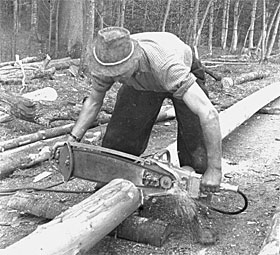 |
| One of the first one-man chainsaws developed in the mid-20th century, marking a major step in the evolution of chainsaw technology. |
| |
| Photos: Archives WSL |
Next time you're using your chainsaw, you might pause and wonder where that roaring little machine actually came from. The answer is stranger than you'd guess. The chainsaw didn't start life in a forest or a workshop; it started in an operating theatre. What follows is the surprisingly unexpected medical origins, and eventually very practical story of how a surgeon's tool became the backbone of land management across Central Texas and beyond.
When Was the Chainsaw Invented?
Early chain-based surgical tools were developed in the late 18th century, but the first widely recognized chainsaw was invented by Bernhard Heine in 1830. The first chainsaw appeared in the late 1700s. Two Scottish doctors, John Aitken and James Jeffray, sketched out a hand-cranked chain-bladed device around 1783–1785. It looked a bit like a kitchen whisk crossed with a bicycle chain, and it was small enough to hold in one hand.
So if you've ever asked yourself, "when was the chainsaw invented?", the short answer is more than 240 years ago. The tree-cutting version you'd recognise today came much later, in the early 20th century. Chainsaw history has two distinct chapters: the medical era and the timber era.
Why Were Chainsaws Invented?
Chainsaws were invented to cut bone faster, cleaner, and with less trauma than a standard handsaw. In an age before anaesthesia and antibiotics, speed in the operating room wasn't a luxury. It was survival. A procedure that took three minutes with a straight blade might take under one with a flexible chain.
So why were chainsaws invented? To reduce suffering during surgery. That's the honest answer. The jump from surgical theatre to logging camp took well over a century, and it required a complete rethink of scale, power, and purpose.
What Were Chainsaws Originally Used For?
Originally, chainsaws were used for a surgical procedure called symphysiotomy, along with the removal of diseased bone. Symphysiotomy involved cutting through the pelvic cartilage and bone during difficult childbirth, grim by modern standards, but occasionally necessary before caesarean sections were safe.
The early device, known as the osteotome, had fine serrated links driven by a hand crank. Surgeons used it for amputations and joint work, too. If you're asking what were chainsaws invented for, the straight answer is obstetrics and orthopaedic surgery. Timber came much, much later.
Were Chainsaws Invented for Childbirth?
Yes, in a roundabout way. The original chainsaw was specifically designed to assist with obstructed labour through symphysiotomy. Before the caesarean became reliably survivable in the mid-1800s, doctors needed a way to widen the pelvic opening when a baby couldn't pass through.
Aitken and Jeffray's chain blade gave them a controlled, quicker cut through cartilage and pubic bone. Was it brutal? By today's standards, yes. By 1780s standards, it was genuine progress. The tool saved lives, both mother and child, at a time when the alternatives were far worse.
Who Invented the Chainsaw?
Credit for the first chainsaw goes to John Aitken, an Edinburgh surgeon, who described the chain-driven saw in his 1785 textbook Principles of Midwifery, or Puerperal Medicine. His colleague James Jeffray refined the design and is often named alongside him.
Decades later, German orthopaedist Bernhard Heine invented the osteotome in 1830, a more polished, guided chainsaw for bone work that spread across European hospitals.
The mechanical, petrol-driven chainsaw you'd picture today came from Andreas Stihl, who patented an electric version in 1926 and a petrol model in 1929.
Chainsaw Origin: From Surgery to Forestry
The leap from operating table to tree trunk didn't happen overnight. Once caesarean sections became safer and surgical saws were replaced by more refined instruments in the late 1800s, the chain-blade concept sat dormant for a while.
Then inventors started asking a different question: what if you scaled it up? What if you bolted it to a motor? Early 20th-century logging was still done with two-man crosscut saws, backbreaking work that could take a full day to fell a single large tree, especially without a sharp chain for efficient cutting. The chainsaw origin story pivoted here, from medicine to mechanised timber.
Timeline: The Evolution of the Chainsaw
A quick walk through chainsaw history:
- 1785 – Aitken's hand-cranked chainsaw was described for surgical use.
- 1830 – Heine's osteotome refines the medical chainsaw.
- 1905 – Samuel J. Bens files the first US patent for an "endless chainsaw" intended to fell giant redwoods.
- 1918 – Canadian James Shand patents a portable chainsaw.
- 1926 – Andreas Stihl patents an electric chainsaw for bucking timber.
- 1929 – Stihl releases the first petrol-powered chainsaw, weighing about 46 kg and requiring two operators.
- 1950s – One-man chainsaws become widely available after aluminium alloys cut the weight roughly in half.
- 1960s–70s – Anti-vibration handles, automatic chain oilers, and chain brakes arrive.
- Today – Battery-electric models rival petrol saws in power, with far less noise.
How the Modern Chainsaw Developed
The modern chainsaw owes its shape to three big shifts, but using one effectively still depends on understanding the basic setup and operation.
First, lighter metals in the post-war years meant one person could finally carry and operate a saw solo.
Second, the chain brake, introduced by Husqvarna and Stihl in the early 1970s, dramatically cut kickback injuries and made proper safety precautions a core part of chainsaw use.
Third, lithium-ion batteries changed everything again in the 2010s.
Conclusion
The chainsaw's path from a surgeon's hand-cranked blade to the tool now found on job sites, farms, and properties across the world is not the story most people expect. It moved through operating theatres, obstetric wards, and logging camps before anyone thought to make it lighter, safer, or battery-powered.
That backstory does not change how the saw cuts. But it does say something interesting about how the most practical tools we rely on today often started somewhere completely different.